Is there any greater false manichean choice than the idea that liberty and virtue are in opposition and that the government can not push one except at the expense of the other… or indeed that government is the proper vehicle to push either?
Far too many people, as of late, believe that materialism and prosperity is destroying the spiritual good and that the economy has become a god unto itself that the country (through the state, of course) worships, and that the only alternative is for the government to subsume the economy into a tool to work for the country, as guided by an enlightened state of course, and towards some virtuous society as determined by the enlightened few who run the government.
This is, as it always has been, a false dilemma fallacy. The “market” is just the free interaction of free individuals, and these people can not brook people who exercise their freedom contrary to their idea of how things ought to be, which is dishonestly packaged as the “common good”.
The proper role of American governance is a constrained one, and limited by our unique heritage and culture going back to the better part of a millennium. The Mangna Carta and the Charter of the Forest made it clear that there were fundamental rights that not even the state could trample upon—the state must be yoked lest it yoke the people. It is that history and heritage which confines the state to limited to the confines of fundamental precepts, and enshrined in the Constitution as a paragon of that wisdom. As Edmund Burke noted:
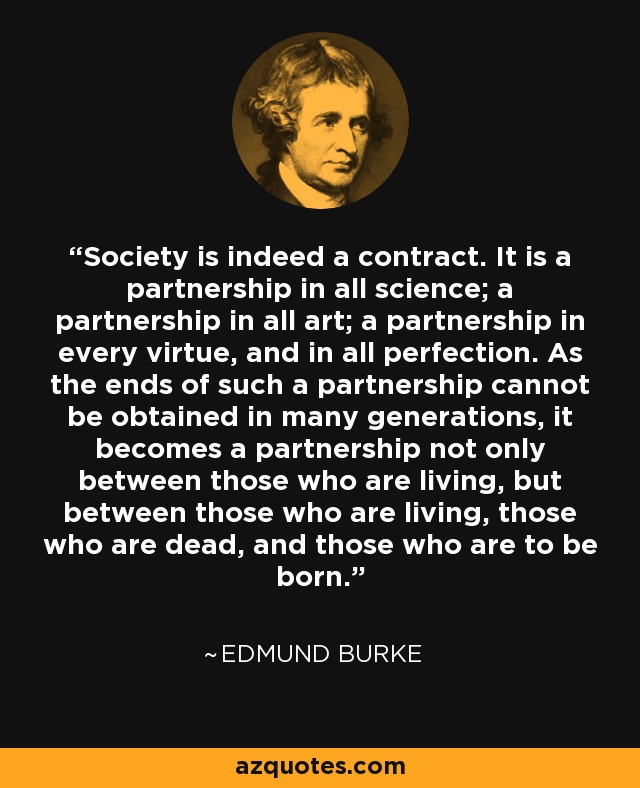
Is that constraining of the state to acting within the substance and fundamentals of America’s heritage, and the liberties that protects, that serve as the glue that we hold individually in common that makes America, America. It is not a “shared good” provided from some societal collective, and certainly not something the state can be trusted to judge as desirable or not. It must come organically from the people themselves, and while the state will reflect that, empowering it to specific social ends is destructive of any “good”.
America is defined by our unique values that come organically by the individuals who share that in common. A state can’t impose them or direct the resulting society, but at best support the fundamental values like limited government and inalienable rights. Things like “faith, family, and freedom” are, while important, not uniquely American but quite widely held, in some form or another. The glue that holds America together is those things which make us not only different from and better than the rest of the world, but uniquely exceptional.
Society can not be engineered or maintained like some machine. The state can’t shape society nor can it be “guided” by it as if it were some collective will. Vague and generic “values” like “the family, the language or the burial of the dead” don’t even rise to anything that could “guide” a state, but rather provide a generic excuse to exercise power.
The state ought to reflect society and the people thereof, and it is that very constraint of history and heritage, specifically the fundamentals and substance thereof, that is most conduce towards American virtue.
This American identity from our rich American pageant is not some construct or prospective artificial ideology, nor is it determined, invented by, or even maintained by the state or some collective will or sentiment “society”, but the sentiments that free people hold individually in common with each other and a descriptive understanding of what was already there. Who we are and what we had in common existed prior to America becoming a country… or a government.