Carl Schmitt, of the “Friend-Enemy” distinction recently whitewashed by Adrienne Vermuele, isn’t the only Nazi legal theorists. Seems, that the “Friend-Enemy” distinction wasn’t the only thing many in the modern day have endorsed from the theories of National Socialism, with many on the purported “Right” increasingly accepting the Anti-Capitalist stance of the National Socialists:
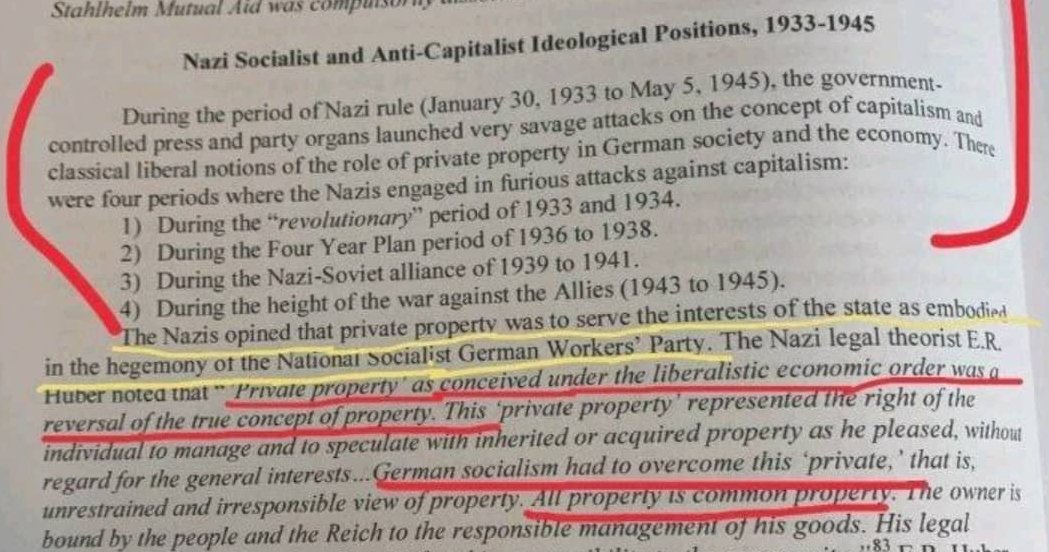
"All property is common property" – Ernst Rudolf Huber, Nazi legal theorist
CommuNazism is its clearest form right there. https://t.co/2OcwV2QoMB
— Martinez Politics (@martinez_clips) October 25, 2026
Of course, it goes much deeper than that.
“De facto government ownership of the means of production […] was logically implied by such fundamental collectivist principles embraced by the Nazis as that the common good comes before the private good and the individual exists as a means to the ends of the State. If the individual is a means to the ends of the State, so too, of course, is his property. Just as he is owned by the State, his property is also owned by the State.”
And yes, “the common good” which can override individual inalienable rights is just as innately socialist as formal government ownership of property.
“Under a system of de jure socialism, such as existed in Soviet Russia, in which the legal code of the country openly and explicitly makes the government the owner of the means of production, all black-market activity necessarily entails the misappropriation or theft of state property. For example, the factory workers or managers in Soviet Russia who turned out products that they sold in the black market were considered as stealing the raw materials supplied by the state.
“Furthermore, in any type of socialist state, Nazi or Communist, the government’s economic plan is part of the supreme law of the land. We all have a good idea of how chaotic the so-called planning process of socialism is. Its further disruption by workers and managers siphoning off materials and supplies to produce for the black market, is something which a socialist state is logically entitled to regard as an act of sabotage of its national economic plan. And sabotage is how the legal code of a socialist state does regard it. Consistent with this fact, black-market activity in a socialist country often carries the death penalty.”
The Nazis themselves often boasted of being socialist.
“While the state was to direct the economy according to the principle “common interest before self-interest” and to set the objectives, within this framework the principle of competition was not to be abolished, because in Hitler’s view it was an important mainspring for economic development and technical progress. What was important, however, was that Hitler did not share the beliefs of economic liberalism, according to which the common good would come about as a result of the play of the various self-interests.
“This is made clear in a speech Hitler delivered on November, 13 1930:
“‘In all of business, in all of life in fact, we will have to do away with the concept that the benefit to the individual is what is most important, and that from the self-interest of the individual the benefit to the whole is built up, therefore that it is the benefit to the individual which only makes up the benefit to the community at all. The opposite is true. The benefit to the community determines the benefit to the individual. The profit of the individual is only weighed out from the profit of the community…. If this principle is not accepted, then an egoism must necessarily develop which will destroy the community.’
“…
“On July 5, 1942 Hitler expressed the opinion that if the German economy had been able so far to deal with innumerable problems “… this was also due in the end to the fact that the direction of the economy had gradually become more controlled by the state. Only thus had it been possible to enforce the overall national objective against the interests of individual groups. Even after the war we would not be able to renounce state control of the economy, because then every interest group would think exclusively of the fulfillment of its wishes.”
“Hitler’s view of the Soviet economic system apparently also changed from skepticism to admiration. In a table talk on July 22, 1942, Hitler vehemently defended the Soviet economic system and even the so-called “Stachanow System,” which it was “exceedingly stupid” to ridicule: ‘One has to have unqualified respect for Stalin. In his way, the guy is quite a genius! His ideals such as Genghis Khan and so forth he knows very well, and his economic planning is so all-encompassing that it is only exceeded by our own Four-Year Plan. I have no doubts whatsoever that there have been no unemployed in the USSR, as opposed to capitalist countries such as the USA.’”

Furthermore, Hitler made it clear that Capitalism had to go:
“The German dictator admitted during a conversation with Benito Mussolini on April 22, 1944, he had become convinced: ‘Capitalism too had run its course, the nations were no longer willing to stand for it. The victors to survive would be Fascism, and National Socialism – maybe Bolshevism in the East.’
“Hitler himself was convinced, as he emphasized in his last radio address on January, 30, 1945, “that the age of unrestricted economic liberalism had outlived itself.” These statements of Hitler’s in 1935 to 1945, but particularly from the beginning of the 1940s on, show that he had become a vehement critic of the system of free enterprise and a confirmed adherent of the system of a planned, state-controlled economy.”
From the devil’s mouth itself.