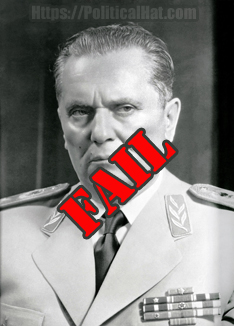
One of the explanations for why Communism failed was that it engaged in centralized planning, especially through top-down command and control dictates. Other forms of socialism, then, without that centralized planning, is then almost as often offered up as a plausible alternative. However, a de-centralized socialist model has already been tried in Yugoslavia under Tito. Needless to say, it failed, as Twitter/X user “Handre” explains, which is quoted in full due to Twitter’s/X’s embed limitations.
Josip Broz Tito built Yugoslavia’s socialist economy on a supposedly clever premise: worker self-management. Factories would be run by elected workers’ councils rather than central planners in Belgrade. Western intellectuals practically wept with admiration. Here, finally, was socialism with a human face.
But the math never worked.
Worker-managed firms systematically chose higher wages over capital reinvestment, because workers capturing today’s income had no personal stake in machinery that would outlast their tenure. The incentive to maintain and expand productive capital simply vanished.
Futher:
Yugoslav firms borrowed heavily from state banks to cover the gap, and those banks lent freely because the political cost of bankruptcy was too high for any official to absorb. Inflation ran at 30% annually through most of the 1980s, eventually hitting 2,665% in 1989. You didn’t need to theorize about the collapse; you could read it on the price tags.
Tito papered over the structural rot with Western loans. Yugoslavia accumulated $20 billion in foreign debt by his death in 1980. That borrowing bought political legitimacy, but not productive capacity. When global interest rates spiked under Volcker’s Fed, the debt service alone crushed the economy.
The decentralization of Tito’s model also contained a fatal political logic. Each of Yugoslavia’s six republics developed its own economic fiefdom, protecting regional industries from competition with other regions. Six separate planning bureaucracies fought over the same shrinking pie. Slovenia and Croatia, the most productive republics, grew resentful of transfers flowing south and west.
Property rights remained collectivized throughout. No worker actually owned his share of the firm, which meant he couldn’t sell it, pledge it, or use it to signal genuine economic preferences. Prices carried noise instead of information. Capital flowed toward political favor rather than toward producers with better ideas.
Socialism doesn’t work, whether it’s centralized or decentralized.
You can’t defeat rational self-interest with high-minded collectivist ideas.