Is there anymore fanciful fantasy than Communism?
“Yuri Brzmenov’s Ghost” tells the tall tale (quote in full below due to the limitations of Twitter’s/X’s embed).
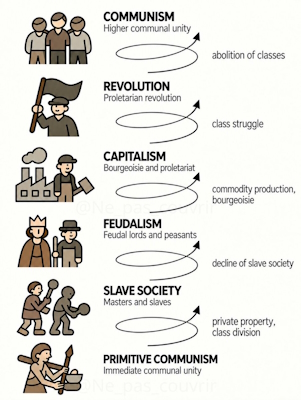
Heres the left fairy tale. Once upon a time, there was primitive communism, an immediate, low communal unity. Common life has not yet fractured into antagonistic classes. People were just vibing, maaan.
Then the common world starts to break apart. Shared resources become property. Authority becomes hierarchy. Social differences harden into class. The deeper rupture comes when powers once embedded in common life separate from it and confront the people who sustain them as independent forces.
That’s alienation. Human beings sustain social powers through their own activity, but those powers separate from the people and relationships that sustain them and come back as something external they have to answer to. Think of your dream job becoming a grinding job. Your own work comes back at you as schedules, hierarchy, metrics, and rules you have to obey. Alienation is the separation of human social power from the people whose activity sustains it.
Reification goes a step further. It encases that separated human social power in a thing-like form. The living human activity and relationships remain underneath, but the form hides them and appears to have a life and authority of its own. The job becomes “the position.” Cooperation appears as a power of “the company.” Hiring and wages appear as “the labor market.”
Alienation separates the power. Reification gives that separated power a thing-like shell that hides the human activity inside it. The shell then appears independent and self-standing, as though the power belonged to the form itself. Workers cooperate, but the company appears to possess the productive power. People exchange goods, but “the market” appears to set prices. People make and enforce rules, but “the institution” appears to command.
So, in the left frame, you live inside the inversion and mistake it for reality itself.
The inversion lies in where the power appears to reside. Human beings sustain social life, but the powers generated through their activity appear to belong to the forms organizing it. Capital “creates jobs.” Markets “demand” cuts. The economy “needs” growth. The social form becomes the apparent actor while the human activity sustaining it fades from view.
The forms themselves are real. The company, market, wage relation, and institution actually exist. Human capacities organized through these forms come to look like powers inherent in the forms themselves. Marx repeatedly describes labor’s own powers confronting labor as powers of capital. Lukács calls this apparent independence “phantom objectivity.”
Taken together, these hardened forms make up “the system.” Nobody has to design it. Property relations, markets, laws, institutions, bureaucracies, and habits accumulate historically, and each generation inherits them as the world already in place. People reproduce them simply by acting inside them: workers sell labor, firms compete, owners invest, bureaucrats apply rules, consumers buy and sell. The result here is a social order sustained by human activity that confronts people as an external power, organizing their capacities and then appearing to be the source of those capacities itself.
Further.
So, as the left fairy tale moves forward, domination becomes less personal and harder to see. Start at the bottom of the image.
Under slavery, domination is naked. One person literally owns another. The human being becomes property. Who dominates whom is really easy to see.
Under feudalism, domination is still personal, but it is woven into an entire social order, making it a little harder to see. Land, lordship, church, rank, inheritance, and custom tell people where they belong and whom they owe.
Under capitalism, the relation becomes much more impersonal and less visible. Marx describes this as personal independence founded on objective dependence. You are formally free. Nobody owns you. You can quit your job. You can sign contracts and buy and sell property.
But you still need money to live. Workers have to sell their labor. Firms have to compete. Businesses have to make profits. Debtors have to make payments. Wages, prices, contracts, markets, corporations, and bureaucracies organize the field in which everybody acts.
So domination no longer has to look like a master commanding a slave or a lord commanding a serf. The company “has to cut costs.” The landlord says “the market sets the rent.” A factory closes because the numbers no longer work. The pressure appears to come from impersonal forces rather than another person.
This is why capitalism generalizes reification. Human relations increasingly confront people in the form of things, prices, contracts, markets, institutions, and apparently objective necessities.
Capitalism also expands science, technology, cooperation, productive capacity, and social interdependence. It develops these capacities in alienated form, but they remain human capacities.
The system becomes hardest to see when it stops looking like a system and starts looking like reality itself.
Lukács calls this second nature. Human beings build a social order and then encounter it like weather or gravity, as something simply given. Prices rise. Companies close. Jobs disappear. Markets move. People say, “That’s just how the economy works.” What history produced now appears natural and necessary.
Mystification becomes a reproductive advantage for the system.
Lukács calls the habit of taking these visible forms at face value immediacy. A wage is just a wage. A price is just a price. A job is just a job. Immediacy sees the thing. Critical consciousness asks what relations produced it.
Critical consciousness begins undoing reification by reconstructing the concealed relations behind visible forms. A commodity becomes more than an object with a price; it reveals labor, ownership, production, and exchange. Capital stops looking like an independently productive thing and reveals the human social power organized through it.
What appeared natural becomes historical. What appeared autonomous reveals its human dependence. The forms are real, but critique distinguishes the human capacities from the forms organizing them: cooperation from capital, interdependence from the market, and collective capacity from the institution.
That distinction is the bridge from critique to repair. Cue the entrance of your lefty hero.
The theory now needs someone who can see through the shell. Class consciousness means seeing the human relations hidden behind the things and grasping the totality: the larger social process connecting apparently separate facts. A job connects to wages, ownership, production, law, markets, class, and capital. What looks like an isolated fact becomes one piece of the whole.
For Lukács, the proletariat occupies the historically privileged standpoint from which this whole can be seen. The worker experiences capitalism both as a human being and as labor-power bought, measured, priced, and used in production. The Party can then become the organized bearer of that class consciousness.
You see a job. The lefty hero sees the social relations behind it.
Praxis turns that vision into action. Once the hidden relations are understood, they can be changed. The point is to intervene in the relations that keep reproducing the larger system.
And capitalism has already done something crucial. It has developed immense productive, technical, intellectual, and cooperative powers while alienating them from the people whose activity sustains them.
It develops what the revolution later claims.
Revolution therefore confronts developed human capacities trapped inside alien social forms. The infrastructure, science, technology, logistics, administration, and technical knowledge already exist. The revolutionary claim is that these powers only appear to belong to capital because capital is the form through which they are organized.
Reappropriation is the recovery of those developed human powers from the alien forms that organize them. The capacities remain; the relations organizing them are transformed.
Revolution generalizes that recovery. Class itself has to disappear because class division belongs to the original rupture. The proletariat completes its role by abolishing the relation that makes it a proletariat.
The story then ends in unity again, but at a higher level. Primitive communism was immediate, undeveloped communal unity. History differentiated and enormously expanded human social powers, but alienated them. Communism promises their conscious reintegration: developed and differentiated social powers consciously organized by associated individuals.
The original unity was simple because little had yet developed. The final unity is supposed to preserve everything history developed while stripping away the alien forms that made those powers confront human beings as something foreign. Just vibin’ with all the goodies of the modern world, maaaan.
There are plenty of other tall tales and fanciful fairy tales, but this one is certainly a doozy.