Eight hundred years ago today, the Magna Carta was signed at Runnymede. This document confirmed ancient liberties and supremacy of law over the state, and stands as the cornerstone of not just English law, but of the entire Anglo-sphere, including the United States of America.
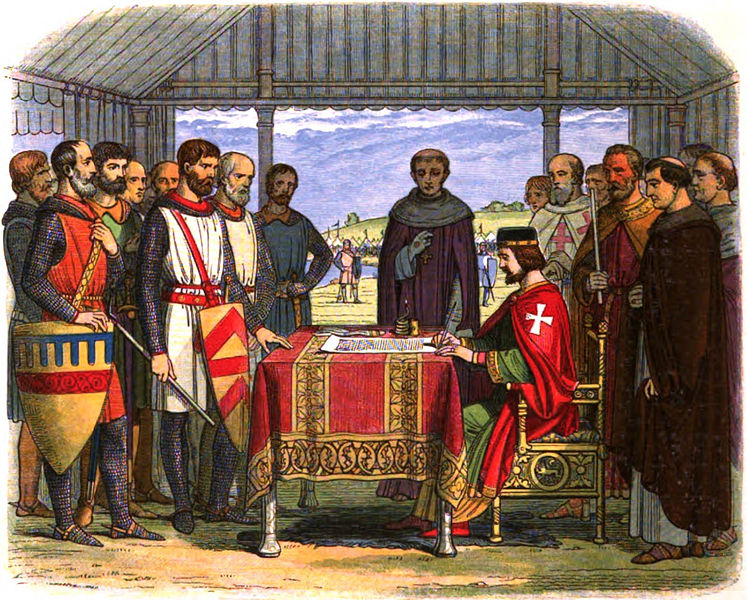
Though much of the Magna Carta dealt with minutia and relations of the Barons with King John, it included provisions of a wider declaration of law and liberty. All but three provisions have been removed or changed. One deals with the freedom of the church, which is reflected in American law via the 1st Amendment, and another protecting the customs and liberties of the cities, which is reflected in American law via the 10th Amendment. The third was a stand against arbitrary and capricious rule of anyone, including the state, and for the rule of law:
“39. No freemen shall be taken or imprisoned or disseised or exiled or in any way destroyed, nor will we go upon him nor send upon him, except by the lawful judgment of his peers or by the law of the land.”
Indeed, several other provisions, lead to core precepts that we still hold true today. The protection of hearth and home, seen today in Homestead Exemptions, was recognized:
“9. Neither we nor our bailiffs will seize any land or rent for any debt, as long as the chattels of the debtor are sufficient to repay the debt; nor shall the sureties of the debtor be distrained so long as the principal debtor is able to satisfy the debt…”
The idea of “no taxation without representation” was not American Revolutionaries rejecting English law, but of expressing an ancient right:
“12. No scutage not aid shall be imposed on our kingdom, unless by common counsel of our kingdom…”
The basis for Parliament, and all legislative chambers in the Anglo-Sphere, grew from the Magna Carta as well:
“14. And for obtaining the common counsel of the kingdom anent the assessing of an aid (except in the three cases aforesaid) or of a scutage, we will cause to be summoned the archbishops, bishops, abbots, earls, and greater barons, severally by our letters…”
The sanctity of the courts as the exercise of justice, and not of politics, was established; the right to justice and protected of the law, by the law, and under the law was held sacrosanct:
“17. Common pleas shall not follow our court, but shall be held in some fixed place.”
“20. A freeman shall not be amerced for a slight offense, except in accordance with the degree of the offense; and for a grave offense he shall be amerced in accordance with the gravity of the offense, yet saving always his ‘contentment’; and a merchant in the same way, saving his ‘merchandise’; and a villein shall be amerced in the same way, saving his ‘wainage’ if they have fallen into our mercy: and none of the aforesaid amercements shall be imposed except by the oath of honest men of the neighborhood.”
“40. To no one will we sell, to no one will we refuse or delay, right or justice.”
“45. We will appoint as justices, constables, sheriffs, or bailiffs only such as know the law of the realm and mean to observe it well.”
Continue reading →