
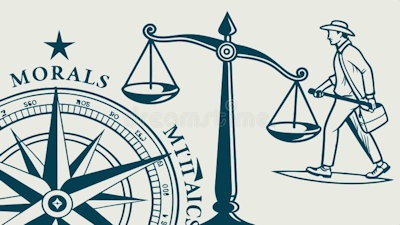
Is the Law the fount of morality or is morality the faunt of law? Quite a philosophical debate, and a question often co-opted by dialectical (Marxist) tactics, as James Lindsay explains.
“All law legislates morality.”
And then the arguments begin…
This particular lie is an interesting one because it isn’t necessarily false in and of itself; it’s just misdirecting. The goal of this statement is to displace the argument from the right grounds to wrong ones.
This is a typical kind of manipulation in dialectical political warfare. By getting people to argue about a subject in the wrong way, they can advance their agenda through the energy generated by the argument. Meanwhile, the argument itself being held on the wrong terms and in the wrong place prevents the opposition from mounting a suitable defense.
In free countries, or generally not-totalitarian situations, the law doesn’t touch most of life. This is psychologically tricky because when you think of law or regulations, you think of the places it does touch, making it hard to think of all the places it doesn’t.
The First Amendment in the American system includes both an Establishment Clause and a Free-exercise clause regarding the practice of religion, for example. This is the state explicitly saying that it will have no business in this system legislating religion. Outside of the protections to everyone’s inalienable rights, the American state willfully steps outside of giving law jurisdiction over religious exercise. In plain language, you have religious liberty here.
In the American system, further, we have “self-governance,” which is based on the idea that the law will touch as little as possible so that people can manage their own affairs with the greatest liberty possible. That’s not to say there’s no law or that it doesn’t limit human behaviors; it’s to say that the law minimizes its jurisdiction, enabling the sovereignty of the individual over the affairs of his own life to the maximal degree possible in a Just society.
I understand that we have lots of regulations and in many situations might actually be overregulated (though underregulated in other areas, no doubt). Getting jurisdiction right is hard, but the point is that jurisdiction of law is the actual argument being proposed, not the nature of what law itself is.
Now, it might or might not be true that all legislation/law imposes morality. That’s an interesting philosophical discussion, I guess. The conventional view is that they overlap but aren’t identical, but, honestly, who cares in day-to-day life? The point here is that it simply isn’t the point. The point is not about the nature of law (what law is) but about the jurisdiction of law (where and to what law applies).
The Woke Right want to expand the reach of law. That is, they want to impose (their own) “moral” laws in places where we, in free societies, generally reject the idea that law should apply, like inside the privacy of your home to things that cause no direct harm to anyone and don’t violate anyone else’s inalienable rights.
The argument we should be having with them is whether or not we should expand the reach of law, or even whether or not we should give them control over that expansion, especially when they intend to do it in a blatantly sectarian way.
The Woke Right’s goal is to get people arguing about whether or not we “legislate morality” so they can say “all law legislates morality” and add in the implication that they can expand the jurisdiction of where they can legislate according to their own morality.
The real question on the table isn’t whether or not the law, as law, concerns the state imposing morality; it’s whether the state has any right to reach into the places it has no business reaching. By getting us to argue about whether or not the law, as law, is morality in legal form, we lose track of the fact that the argument is one of jurisdiction, not the nature of law.
Worse, by taking up this argument, we give the people inducing it ample ground to make a strong case that what they’re proposing is not unreasonable. They can make a strong case that law legislates morality in some way or another, and thus seem reasonable in their real, but hidden, argument: the state should expand its jurisdiction to legislate things it has no business legislating (e.g., to threaten religious liberty is to overturn the First Amendment, which is in effect to abandon the United States for a different America).
So, let’s untangle what’s really going on with these deceptive arguments and have real discussions.






Pingback: In The Mailbox: 03.31.26 : The Other McCain